Research

My research studies how taxation and regulation shape the behavior of individuals, firms, and digital platforms. I combine quasi-experimental methods with granular micro-data and market data to identify causal effects and understand the real-world consequences of tax policy.

Navigating the Amazon: The Incidence of Digital Service Taxes

Dominika Langenmayr & Rohit Reddy Muddasani
Job Market Paper
Digital Markets Tax Incidence Industrial Organization

Digital Service Taxes are designed to tax digital firms in the markets where their users and customers are located. But who ultimately bears the tax? This paper studies how a digital platform responds to taxation and how the resulting costs propagate through the platform to sellers and ultimately consumers.

Data: Amazon FBA fees and product-level prices
Method: Staggered difference-in-differences
Setting: France, Italy, Spain, UK & Germany

Media Mentions

  • The Economist — “Trump threatens 50% tariffs. How might Europe strike back?” (May 23, 2025)
  • Frankfurter Allgemeine Zeitung — “Wie sinnvoll ist eine Digitalsteuer wirklich?” (July 19, 2025)

Policy Impact

  • Cited in a briefing prepared for the European Parliament Committee on Budgets (BUDG): Could a digital services tax become an EU own resource? (June 2026)
📄 Download Paper SSRN
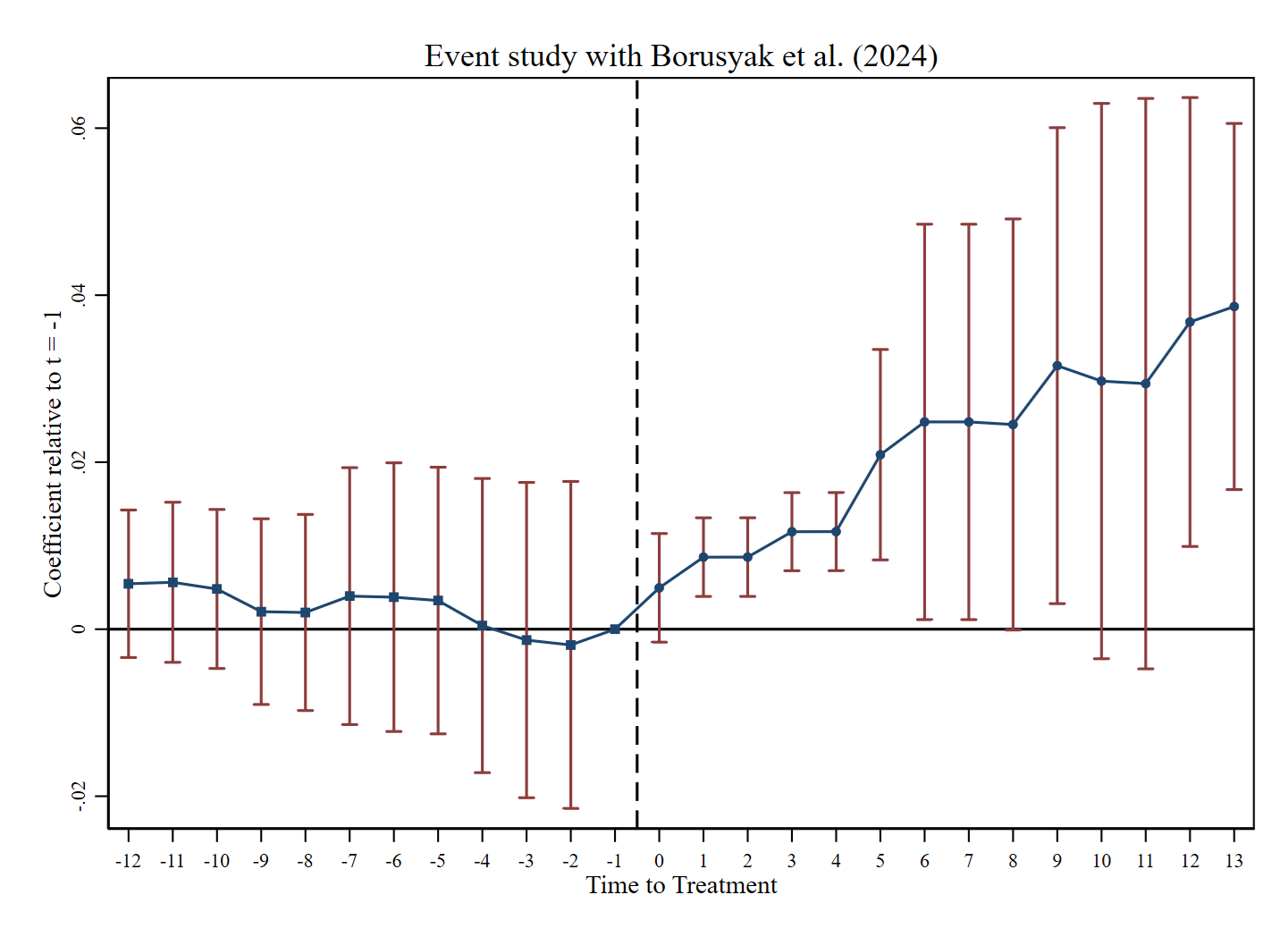
Event study for the effect of Digital Service Taxes on Amazon fees
Event study: effect of Digital Service Taxes on Amazon fees.

Abstract

Firms in the digital economy often pay little tax in the countries where their customers are based. In response, market countries have introduced digital service taxes on the revenue of these firms to indirectly tax their profits. We study the incidence of these taxes using data on Amazon, the largest online retailer. We find that in most countries, Amazon increased its fees by roughly the amount of the digital service tax. Firms using Amazon as a platform have largely passed these increased fees on to consumers. Large digital firms thus bear only a small part of the tax burden, but the tax may nevertheless succeed in making them less competitive relative to brick-and-mortar retailers.

Key Findings

  • A one percentage point increase in the DST raises Amazon's FBA fees by around 0.5%.
  • Pass-through differs across countries: it is more than full in the UK, close to full in France and Spain, and small and statistically insignificant in Italy.
  • Prices for products sold through FBA increase by about 2% following the DST in France, Spain and the UK, with no significant price response in Italy.
  • Consumers bear an estimated 1.5 to 2.5 euros (or pounds) for each euro (or pound) of DST revenue in the countries with substantial pass-through, indicating more-than-full pass-through.
  • Pass-through is stronger for lower-priced goods and weaker for products with highly volatile prices, consistent with differences in the size of the cost shock and the role of algorithmic pricing.
  • The results imply that DSTs are largely borne by domestic market participants rather than the targeted foreign digital firms, while potentially reducing the competitive advantage of digital platforms relative to brick-and-mortar retailers.

Empirical Strategy

The paper first examines Amazon's Fulfillment by Amazon (FBA) fees using variation from the introduction of DSTs in France, Italy, Spain and the United Kingdom, with Germany as the comparison country. It then studies consumer prices using identical products sold by third-party sellers using FBA and products sold directly by Amazon. An instrumental-variable analysis using DST-induced changes in platform fees provides an additional robustness check.
So close and yet so far: The ability of mandatory disclosure rules to crack down on offshore tax evasion

Elisa Casi, Mohammed Mardan & Rohit Reddy Muddasani
Working Paper
Tax Evasion Tax Transparency International Taxation

Can mandatory disclosure rules actually deter offshore tax evasion — or simply redirect it? This paper studies the introduction of DAC6 and examines how individuals respond to increased reporting requirements using bilateral data on cross-border bank deposits.

Data: Bilateral cross-border bank deposits
Method: Difference-in-differences & event study
Setting: EU, non-EU OECD & CBI/RBI residents
📄 Download Paper SSRN
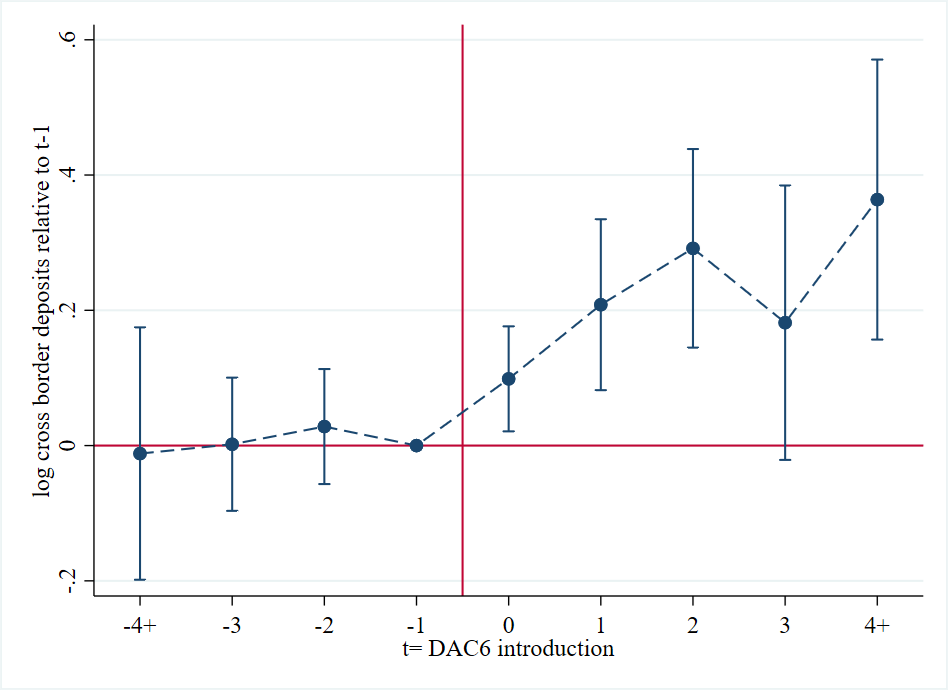
Event study for the effect of DAC6 on cross-border deposits
Event study: effect of DAC6 on cross-border deposits.

Abstract

We study the short-term effect of the introduction of the mandatory disclosure program for aggressive tax arrangements by focusing on the one introduced in May 2018 under the Council Directive 2018/288/EU (or DAC6). Employing bilateral data on cross-border deposits, we study the effect of this new disclosure requirement on cross-border tax evasion. Our results show a reduction of cross-border deposits in EU countries with a strong enforcement, captured by large monetary penalties for misreporting. At the same time, we document a relocation of income and wealth to countries with limited intermediary reporting obligation. Finally, we detect a short-term increase of USD 14 billion in cross-border deposits held by residents of countries offering citizenship/residence by investment programs, suggesting the use of these schemes as regulatory arbitrage to circumvent the disclosure mandated under DAC6. We provide timely and relevant evidence contributing to the debate on international administrative cooperation to reduce cross-border tax evasion.

Key Findings

  • Cross-border deposits of EU residents in the EU increase by 11% after DAC6, corresponding to approximately USD 124 billion.
  • In Spain, where enforcement is particularly strong because penalties are proportional to the value of the incorrectly reported transaction, cross-border deposits decrease by approximately 16% after DAC6.
  • France experiences an approximately 30% increase in cross-border deposits, consistent with the relocation of income and wealth toward an environment with broader legal professional privilege.
  • Residents of citizenship-by-investment and residence-by-investment countries increase their cross-border deposits by approximately 30% after DAC6, corresponding to around USD 14 billion, of which about USD 7 billion is in tax havens outside the EU.
  • Placebo tests using countries with similar disclosure rules already in place before DAC6 do not find a statistically significant treatment effect.
  • Taken together, the findings indicate that mandatory disclosure can affect offshore behavior, but differences in enforcement and reporting obligations create opportunities for regulatory arbitrage.

Empirical Strategy

The study uses bilateral data from the Bank for International Settlements and a difference-in-differences and event-study design. EU residents are compared before and after DAC6 with non-EU OECD residents, who are not affected by the EU directive but face a similar economic and fiscal environment.

Survive, Heal or Die? Zombie Firms and Tax Planning

Rohit Reddy Muddasani
Work in Progress
Corporate Tax Planning Zombie Firms Tax Transparency

What if some financially distressed firms survive not because they are economically viable, but because they serve a purpose within a multinational group? This paper investigates whether persistent loss-making affiliates can play a role in corporate tax planning.

Data: ORBIS firm-level financial data
Method: Difference-in-differences & placebo tests
Setting: Standalone & Group-affiliated zombie firms across countries
Paper Available on Request →
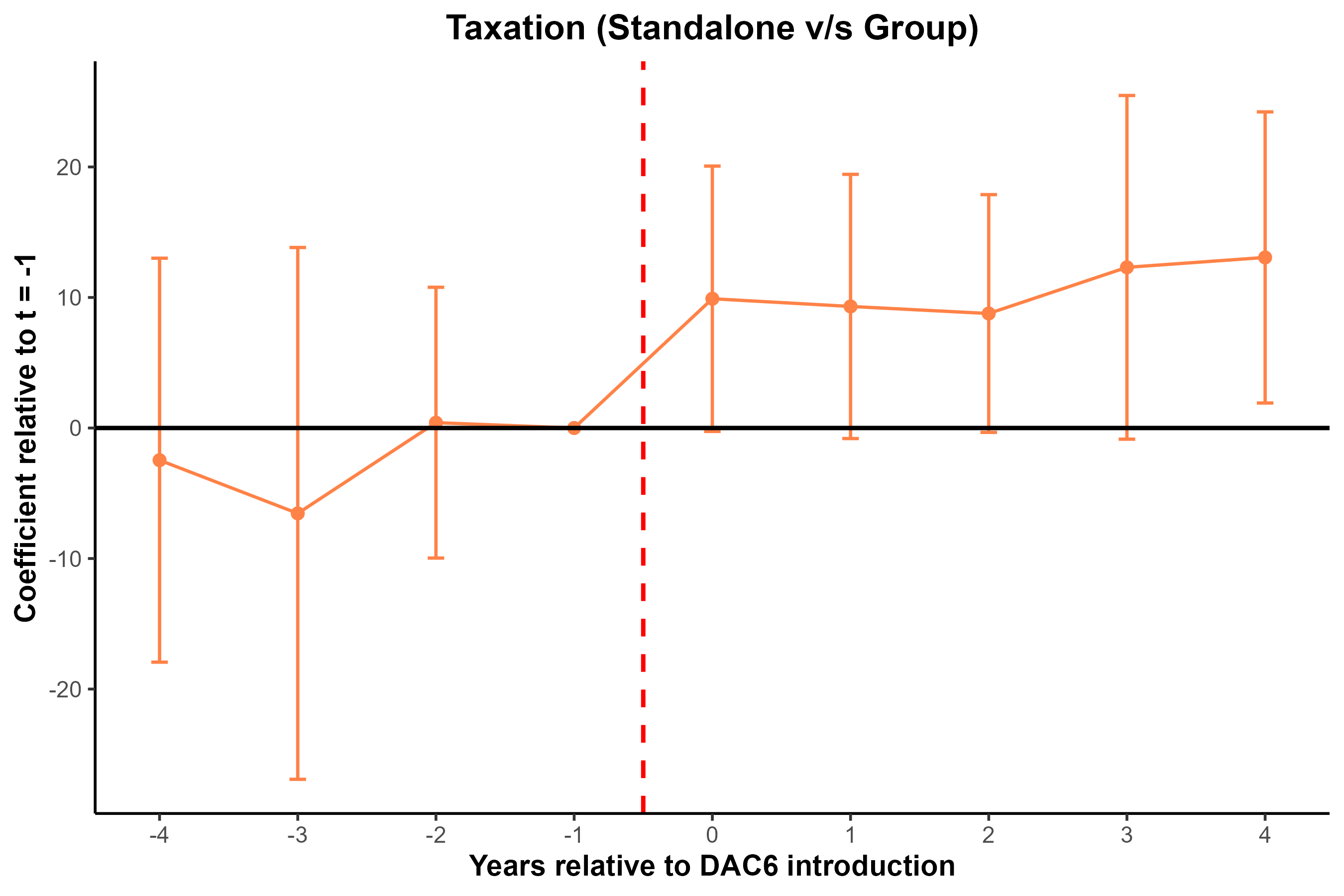
Event study for taxation of standalone versus group firms
Event study: taxation of standalone versus group firms around DAC6.

Abstract

Zombie firms are firms that continue to operate despite prolonged periods of financial distress. When part of a group, such firms may serve as tax planning instruments by facilitating profit shifting or loss offsets. This paper studies the role of zombie firms in group-level tax planning by examining their response to DAC6, an EU directive mandating the disclosure of aggressive tax planning arrangements. Using firm-level data from ORBIS and a differences-in-differences design, I find that following DAC6, group zombie firms in the EU are more likely to exit the market than their non-EU counterparts. Among surviving firms, the probability of remaining a zombie declines for EU group firms. Heterogeneity analyses show that both firm location and group headquarters location shape these responses, highlighting how zombie firms are used within groups for tax planning purposes.

Key Findings

  • Group-affiliated zombie firms in the EU experience significantly higher exit rates after DAC6 than comparable group firms outside the EU.
  • The estimated effect corresponds to approximately 3,400 excess closures of group zombie firms in the EU; a direct EU-versus-non-EU comparison gives an estimate of around 2,100 additional closures attributable to DAC6.
  • The prevalence of zombie firms among group firms in the EU declines significantly after DAC6, with baseline estimates indicating approximately 32,000 fewer zombie firm occurrences relative to comparable firms outside the EU.
  • Both affiliate location and headquarters location shape the response, with firms headquartered in the EU responding more strongly to the increased disclosure requirements.
  • EU group firms pay significantly higher taxes following DAC6, with estimated additional tax payments of approximately $9 billion over a five-year period.
  • Despite the decline in zombie firm occurrence and higher tax payments, reported net profits remain muted and there is no corresponding increase in profitability or equity infusion, highlighting limitations of the directive.

Empirical Strategy

The study uses firm-level financial data from ORBIS and exploits quasi-experimental variation created by DAC6 across firm type and geographic location. It examines zombie-firm exit and the probability of remaining a zombie using a differences-in- differences design, with additional heterogeneity and placebo analyses.

Research Agenda

My broader research agenda examines how taxation and regulation shape market structure, prices, firm organization, and individual behavior. I am particularly interested in the interaction between tax policy, digital markets, and globalization, and in using rigorous empirical methods and unusually detailed micro-data to uncover economic mechanisms that are difficult to observe in conventional datasets. Building on my experience working with pricing, seller, and product-level data from e-commerce platforms, I am also developing research in applied industrial organization, with a particular interest in platform markets, pricing, and firms’ strategic responses to policy.